
Interesting Info -> Lying Index -> Eye Direction & Visual Accessing Cues
 Eye Direction and Lying
Eye Movement and Direction & How it Can Reveal Truth or Lies
This is a continuation of our previous article Detecting Lies. Many comments by our visitors asked about how eye direction can indicate the presence of a lie.
Can the direction a person’s eyes reveal whether or not they are making a truthful statement? Short answer: sort of. But, it isn’t as simple as some recent television shows or movies make it seem.
In these shows a detective will deduce if a person is being untruthful simply because they looked to the left or right while making a statement.
In reality, it would be foolish to make such a snap judgment without further investigation… but the technique does have some merit.
So, here it is… read, ponder and test it on your friends and family to see how reliable it is for yourself.
Visual Accessing Cues – “Lying Eyes”
The first time “Visual Accessing Cues” were discussed (at least to my knowledge), was by Richard Bandler and John Grinder in their book “Frogs into Princes: Neuro Linguistic Programming (NLP) ” From their experiments this is what they found.
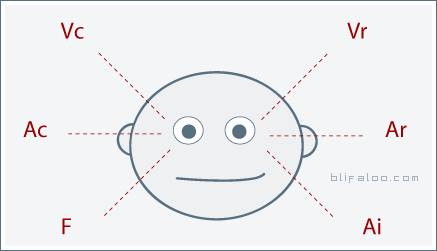
When asked a question a “normally organized” right-handed person looks (from your viewpoint, looking at them):
Up and to the Left Indicates: Visually Constructed Images (Vc)If you asked someone to “Imagine a purple buffalo”, this would be the direction their eyes moved in while thinking about the question as they “Visually Constructed” a purple buffalo in their mind.
Up and to the Right Indicates: Visually Remembered Images (Vr)If you asked someone to “What color was the first house you lived in?”, this would be the direction their eyes moved in while thinking about the question as they “Visually Remembered” the color of their childhood home.
To the Left Indicates: Auditory Constructed (Ac)If you asked someone to “Try and create the highest the sound of the pitch possible in your head”, this would be the direction their eyes moved in while thinking about the question as they “Auditorily Constructed” this this sound that they have never heard of.
To the Right Indicates: Auditory Remembered (Ar)If you asked someone to “Remember what their mother’s voice sounds like “, this would be the direction their eyes moved in while thinking about the question as they “Auditorily Remembered ” this sound.

Down and to the Left Indicates: Feeling / Kinesthetic (F)If you asked someone to “Can you remember the smell of a campfire? “, this would be the direction their eyes moved in while thinking about the question as they used recalled a smell, feeling, or taste.

Down and To the Right Indicates: Internal Dialog (Ai)This is the direction of someone eyes as they “talk to themselves”.
The Gist of it…
How this information is used to detect lies:
Example: Let’s say your child asks you for a cookie, and you ask: “Well, what did your mother say?” As they reply “Mom said… yes.”, they look to the left. This would indicate a made up answer as their eyes are showing a “constructed image or sound. Looking to the right would indicated a “remembered” voice or image, and thus would be telling the truth.
Final Notes:
*** Looking straight ahead or with eyes that are defocused/unmoving is also considered a sign of visual accessing.
*** A typical left-handed person would have the opposite meanings for their eye-directions.
*** As with other signs of lying, you should first establish and understand a persons base-behavior before concluding they are lying by the direction of their eyes.
*** Many critics believe the above is a bunch of bull***t. In my own experiments I have found these techniques to be more true than not. But, why not find out for yourself? Make up a list of questions that like the sample ones, and give them to your friends/family anyone who would be your guinea pig, observe their eye movements and record the results.
*** This guide is hardly in-depth, I recommend getting the book “Frogs into Princes: Neuro Linguistic Programming” by Richard Bandler and John Grinder for a more thorough explanation if the subject interests you.
 Continue Reading Part 3 – Micro Expressions, Subtle Emotions & Lie DetectionContinue Reading:

Micro Expressions and Lying (part 3) Micro Expressions betray us when we lie. We can try to cover our feelings with fake smiles, but involuntary face muscles reveal this hidden emotions. Good introduction with plenty of links and resources.

Statement Analysis – Intro and Resources (part 4) <– Newest Introduction to the process used by investigators for analyzing a person’s words to determine if the subject is being truthful or deceptive. By guest author Mark McClish, Retired U.S. Secret Service Federal Marshall.

Lying Resources, Books & Links (Lie Detection Index Page) Index to all of our lying resource pages, along with additional links, research, videos and books. Start here if you are new to this site.
More How To Guides | Interesting Info Home Page | More Blifaloo!
Comments on Eye Direction & Lying
Read the Comment Archive on Eye direction and lying
About – – Search – Blog – For Webmasters
Blifaloo.com is temporary boredom relief & knowledge for the curious mind. | Proudly Hosted by DreamHost
Copyright 2004 – 2013 |
I think it may be something what true but I believe that a lot of people forget or don’t consider a lot of other factors that come into it when asking a question in a study to a normal conversation with someone they know to say a Doctor. I noticed I’m different and get uncomfortable no matter the topic or who I’m talking to. That may be due to being home schooled. But my eyes go all over the place and I never feel comfortable with eye contact. My body will fidget a lot even when I am telling the truth or a normal no pressure conversation. The things like this make it harder on me because people that go off it will be miss guided. So I really hate it when people say stuff like this is true and you can go by it. At least put that it differs from person to person and if they are a uncomfortable person it may not be right. And make that clear not a little at the bottom because I tried it with some friends and they was the same as me with it.
I don’t think this article is correct. Most of the research I’ve done, the articles say that you look to the right to construct answers, left for memory recall.
What does it mean when some ones eyes dart really fast from left to right and left to right?
When a general accusation was made. The persons eyes went like ping pong balls side to side.